

Discover how Chef (2014) demonstrates social media marketing and content marketing through storytelling, engagement, authenticity, and shareable content.

4 Social Media Marketing Lessons Every Marketer Can Learn from the Movie ‘Chef’
-
- 4 minute read
- 0 Comments
What if your best marketing strategy wasn’t advertising?
What if it was simply sharing your story?
In Jon Favreau’s Chef (2014), Carl Casper’s food truck succeeds without a large advertising budget, celebrity endorsements, or typical marketing tactics. Instead, much of its development is driven by social media engagement, real-time updates, and engaging content.
Although the film is frequently regarded as a story about food and family, it also teaches important lessons about Social Media Marketing and Content Marketing in the digital age.

Social Media as a Business Growth Tool
After leaving his restaurant job, Carl starts a food truck and travels across the United States. Unlike a regular restaurant with a set location, a food truck faces a significant obstacle.
How do customers know where to find it?
This is where social media becomes essential.
Carl’s son, Percy, begins using platforms like Twitter to:

Instead of depending on traditional advertising, the company uses social media to stay in touch with its consumers. This demonstrates one of the key functions of modern social media marketing:
Building direct and ongoing relationships with customers.
Content Marketing Without Calling It Content Marketing
One of the most intriguing elements of Chef is that the actors never talk content strategy while intuitively applying several content marketing techniques. As they drive across the country, Percy shares:
- Photos of the food
- Moments from the road trip
- Behind-the-scenes footage
- Interactions between family members
- Updates from different cities
These posts do more than provide information. They tell a story.
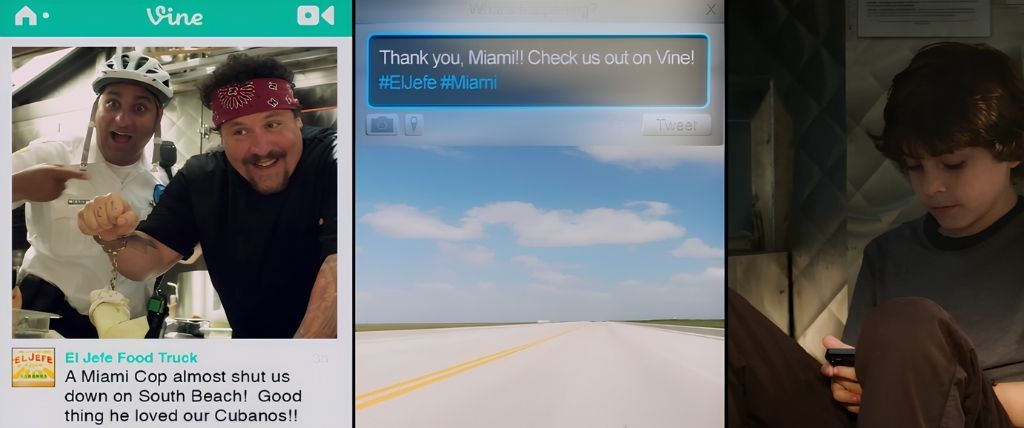
This is the essence of content marketing:
Creating valuable and engaging content that attracts and retains an audience.
People don’t just follow the food truck because of the sandwiches. They follow the experience.
1. Selling the Journey, Not Just the Product

Many businesses focus solely on promoting their products. The food truck succeeds because it emphasises the stories behind what it sells. Followers witness:
- Carl rebuilding his career
- The father-son relationship developing
- New cities and customers
- The process of creating food
The audience becomes emotionally involved in the journey. This is a valuable content marketing lesson. People are usually more interested in stories than in products. A product may draw attention. A story keeps people interested.
2. Behind-the-Scenes Content Creates Authenticity

Authenticity is increasingly important to modern audiences. They want to know what happens behind the scenes, not just the polished promotional words. Chef’s social media content features cuisine preparation, road trip experiences, team interactions, and ordinary events. These authentic insights assist to humanise the brand. Instead of looking to be a business trying to sell anything, the food truck feels like a genuine experience provided by real people. This sincerity builds trust and promotes audience participation.
3. Why Shareable Content Matters
Not every content attracts attention. The most effective content is what people want to share. The photos, updates, and videos shared during the film are visually appealing, intimate, interesting, and simple to follow. As followers share this information with others, the food truck expands its following without spending major advertising costs. This exemplifies a fundamental principle of social media marketing:
Content becomes more valuable when audiences help distribute it.
Every share expands visibility. Every interaction increases reach. Every post creates another opportunity for discovery.
4. Building a Community Instead of an Audience

One of the most significant contrasts between traditional and social media marketing is the move from delivering messages to community building. Carl’s followers are not passive viewers. They actively follow updates, share content, visit the food truck, and suggest it to others. Over time, the relationship evolves beyond transactional. People feel linked to the brand. This sense of community creates loyalty, a result that advertising alone sometimes fails to achieve.
The Marketing Lesson from Chef
Carl’s food truck’s success isn’t due to a big marketing expenditure. It is fuelled by visibility, engagement, and storytelling. The film explains how social media marketing is more than just posting content. It’s about generating experiences that are worth sharing. Similarly, content marketing does not imply advertising things at every opportunity. It’s about telling stories that people truly care about. When businesses focus on providing valuable experiences, social media becomes more than just a communication tool. It becomes a growth engine.

Beyond the Food Truck: A Lesson in Modern Marketing
At its foundation, Chef demonstrates how social media and content marketing can help a small business become a recognised brand. The food truck’s expansion is not driven by costly advertising initiatives. It is driven by stories, experiences, and personal connections. In today’s digital landscape, consumers do more than just buy products. They follow journeys. Sometimes the most effective marketing does not involve selling at all. It’s giving them something to share.
For the Brave Souls and Scholars
Bu, Y., Parkinson, J., & Thaichon, P. (2021). Digital content marketing as a catalyst for e-WOM in food tourism. Australasian Marketing Journal, 29(2), 142-154. https://doi.org/10.1016/j.ausmj.2020.01.00
Bubphapant, J., & Brandão, A. (2024). Content marketing research: A review and research agenda. International Journal of Consumer Studies, 48(1), e12984. https://doi.org/10.1111/ijcs.12984
Izogo, E. E., & Mpinganjira, M. (2024). Digital content marketing consumption motives in the age of social media: an investigation of relational and monetary outcomes. Aslib Journal of Information Management, 76(2), 353-378. https://doi.org/10.1108/AJIM-07-2022-0347
Lou, C., & Xie, Q. (2021). Something social, something entertaining? How digital content marketing augments consumer experience and brand loyalty. International Journal of Advertising, 40(3), 376-402. https://doi.org/10.1080/02650487.2020.1788311




Leave a Comment