
Discover how The Truman Show predicted hyper-personalization decades before social media algorithms. Explore the marketing psychology behind personalized realities and consumer behavior.
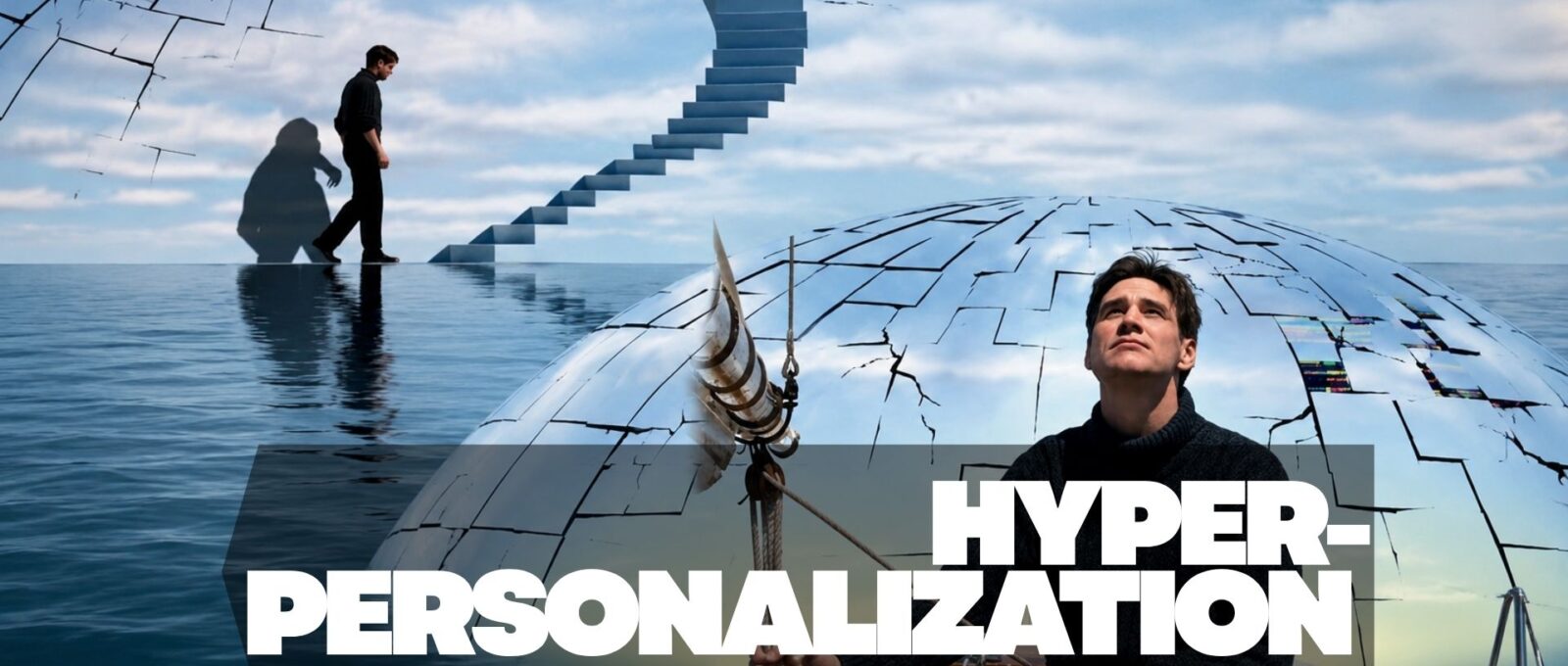
The World Built Just for One Customer: Hyper-Personalization & The Truman Show
-
- 3 minute read
- 0 Comments
Long before TikTok algorithms, personalised suggestions, and targeted advertising, The Truman Show imagined a world built solely around a single person. Truman Burbank looks to have a normal life in the charming town of Seahaven.
But there is one critical detail: the world was not designed for everyone. It was built for Truman.
As a result, the classic film provides a fascinating lens through which to evaluate one of modern marketing’s most strong (and sometimes unseen) forces: hyper-personalization.

A Reality Designed Around One Person
Every aspect of Truman’s surroundings is carefully planned. People, conversations, situations, and even his biggest fears are all made up. Nothing exists without a purpose. Everything is designed to keep him interested, comfortable, and predictable.
In certain ways, Christof (the show’s creator) was not delivering the same experience to everyone. Instead, he was constantly building a world for just one individual. That is the fundamental concept of hyper-personalization: separating from the masses and focusing solely on the individual.
What Exactly Is Hyper-Personalization?

Traditional marketing divides consumers into divisions based on broad demographics such as age, geography, and gender. Hyper-personalization goes a lot deeper. It uses real-time behavioural data, preferences, habits, and context to generate highly personalised experiences.
Instead of asking, “What do customers want?” hyper-personalization asks:
“What does this specific customer want right now?”
Today, we see this architecture at work every time we unlock our devices. Every user experiences a slightly different version of the same platform, in the same way Truman did in a world created specifically for him.
Modern Examples of Hyper-Personalization:
- TikTok’s For You Page: An endless feed tailored to your exact viewing seconds.
- Netflix & Spotify: Custom artwork and playlists (Discover Weekly) designed around your mood and taste.
- Amazon: Product suggestions based not just on what you bought, but what you lingered on.
- Personalized Emails: Campaigns that trigger based on your exact digital footprints.
The Ultimate Goal: Ultimate Engagement
The producers of Truman’s show had a clear, singular goal: Ensure Truman’s participation. Keep him comfy. Prevent him from leaving.
Modern digital platforms share a common objective. This is not necessarily evil; it is simply how involvement influences business outcomes.
The more relevant an experience feels, the loop continues:
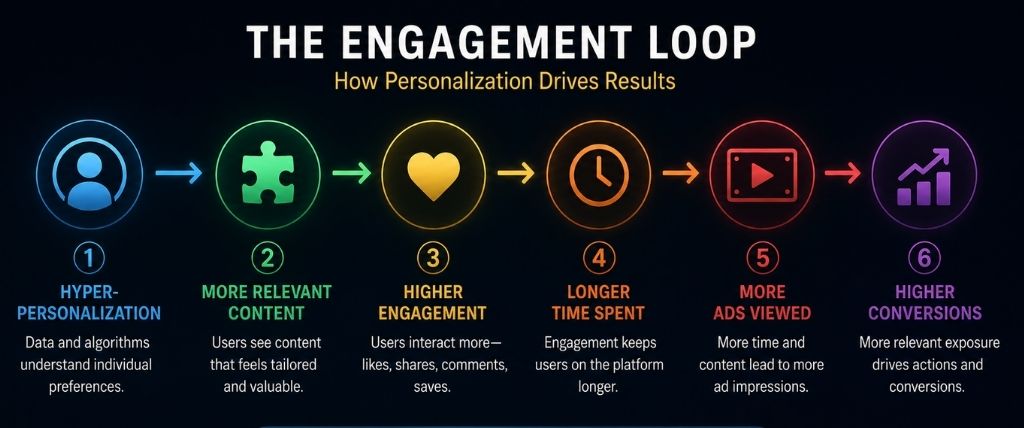
In short, personalisation has emerged as the most effective retention tactic. Seahaven was more than just a village; it was a masterfully crafted retention loop intended to keep Truman within the system.
The Hidden Risk: Living in a Digital “Seahaven”
While hyper-personalization is convenient, the film also reveals a significant drawback. When every experience is personalised to our established tastes, we stop encountering new viewpoints.
Truman simply saw the reality that was prepared for him, never realising that other options existed. Today’s recommendation systems can generate comparable filter bubbles. Algorithms understand what stimulates our interest and keep giving us more of the same, keeping us in an echo chamber.
In the end, what happens? We no longer live in one unified reality. We live in millions of individualised realities.
In Case We Don’t See You: Saying Goodbye to the Algorithm
The Truman Show imagined a future in which experiences are tailored to individual behaviour. What formerly appeared to be dystopian science fiction is now extremely similar to the digital ecosystems with which we engage on a daily basis.
The lesson to be learned here is that personalisation is not always negative; it can often make our digital lives easier. Rather, it serves as a reminder that personalised experiences are never neutral.
They must be designed by someone. Someone optimises them. Someone decides what we see. And, like Truman, we rarely notice the building behind the screen unless we decide to look for the escape.

For the Brave Souls and Scholars
Bozkurt, S., Uğursoy, A. S., & Meral, S. P. (2025). The impact of personalized messages and designs on consumer experiences and marketing communications in technology: Hyper-Personalization. In Impact of contemporary technology on art and design (pp. 135-164). IGI Global Scientific Publishing. DOI: 10.4018/979-8-3693-4318-0.ch007
Jain, G., Paul, J., & Shrivastava, A. (2021). Hyper-personalization, co-creation, digital clienteling and transformation. Journal of Business Research, 124, 12-23. DOI: 10.1016/j.jbusres.2020.11.034
Singh, B., & Kaunert, C. (2024). Future of digital marketing: Hyper-personalized customer dynamic experience with AI-based predictive models. In Revolutionizing the AI-digital landscape (pp. 189-203). Productivity Press.
Valdez Mendia, J. M., & Flores-Cuautle, J. D. J. A. (2022). Toward customer hyper-personalization experience—A data-driven approach. Cogent Business & Management, 9(1), 2041384. https://doi.org/10.1080/23311975.2022.2041384


Leave a Comment