

Learn how Girlboss explains brand naming strategy through Sophia Amoruso’s journey from brainstorming to creating Nasty Gal.
What Girlboss Teaches Us About Brand Naming: It Starts with Identity, Not Creativity
-
- 3 minute read
- 0 Comments
Choosing a brand name can feel like a creative effort. Entrepreneurs open a notepad and write down dozens of ideas, hoping that one of them “feels right.”
However, according to Girlboss (2017), good brand branding requires more than just creativity.
It’s about identity.
Sophia Amoruso spends days looking for the ideal name for Nasty Gal before launching it. Her journey teaches one of the most important branding lessons:
You must first understand who your brand is before naming it.
The First Mistake: Looking for a Name Before Defining an Identity

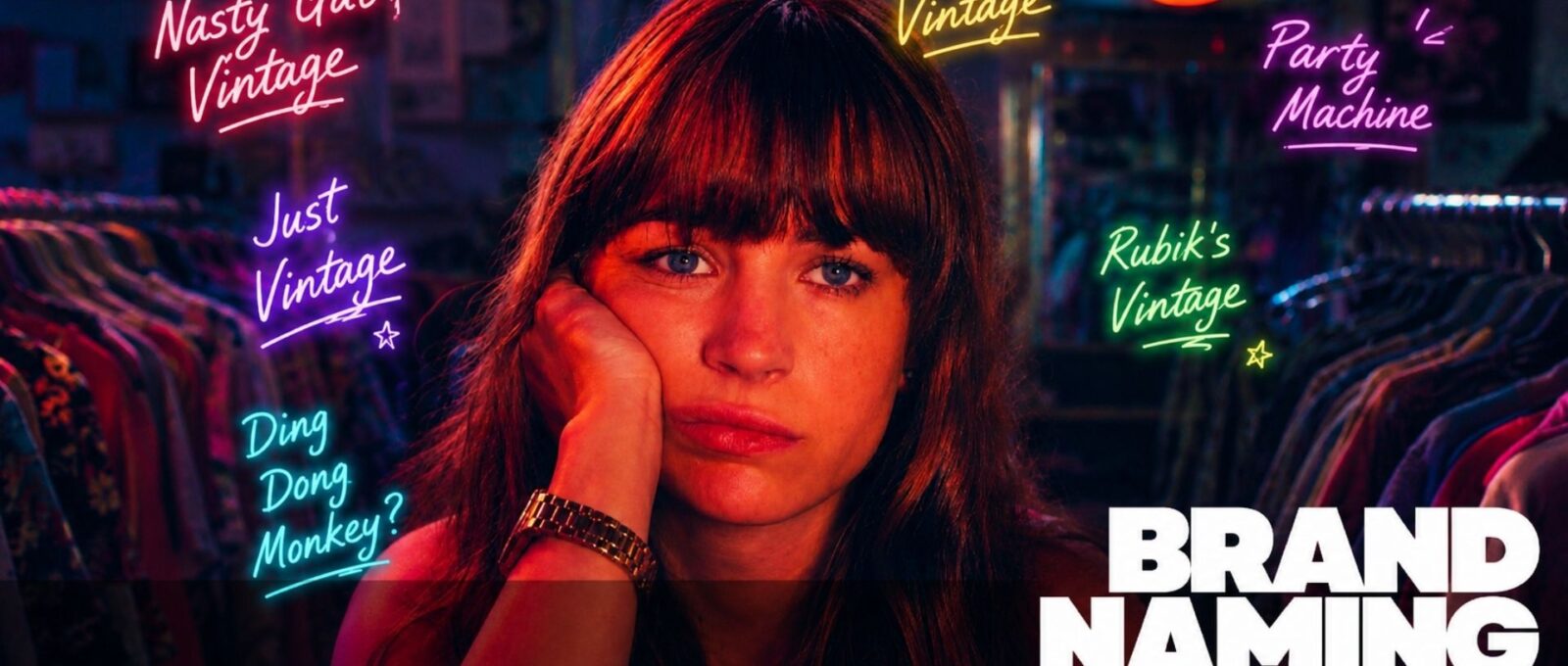
Sophia is desperate to choose a name for her vintage business at the beginning of the series. She looks through lists of vintage-inspired names and fills pages with suggestions like Just Vintage, Minty Vintage, and Dance Machine.
She even considers Rubik’s Vintage, describing it as colourful, complex, and something people must figure out—characteristics she believes represent her own personality. Throughout the process, however, one question repeatedly arises:
“Who am I?”
That question proves to be far more significant than any name she writes down.
A Brand Name Should Reflect the Brand, Not Just the Product

At one point, Sophia says:
When you’re selling something, you want people to believe you. I need a name that reflects me.
This is a turning moment in her branding journey.
Instead than asking, “What should I call my vintage store?” she begins with, “What kind of brand am I trying to build?”
That shift alters everything. A strong brand name does more than just identify a specific product category. It conveys personality, ideals, and attitudes.
Why Sophia Rejected Rubik’s Vintage
Among all her ideas, Rubik’s Vintage is the one Sophia connects with the most. Yet she eventually rejects it. Why?
Not because it was confusing.
Not because it was too long.
Not because it lacked creativity.
Her reason is surprisingly simple: “It’s not special enough. It has to be special. It has to be me.”
This moment highlights an important branding principle. A brand name isn’t successful simply because it’s clever. It needs to feel authentic to the identity the brand wants to project.
The Birth of Nasty Gal

Sophia eventually discovers Nasty Gal, which is inspired by Betty Davis’ 1975 funk album. Unlike many of her previous concepts, the name does not indicate what the company sells. Instead, it conveys an attitude.
Bold.
Confident.
Rebellious.
The name immediately gives the brand a distinct personality—one that precisely complements Sophia’s target audience.
What Marketing Teaches Us About Brand Naming
A strong brand name should do more than identify a product category. It should help people understand who your brand is and build lasting associations with it. When evaluating a potential name, ask yourself:
- Does this name stand out from competitors?
- Does it reflect my brand’s identity and personality?
- Is it memorable after hearing it only once?
- Can it grow with my business over time?
- Would people still remember it without seeing my logo?
If the answer to most of these questions is “no,” it’s probably worth continuing the brainstorming process.
The Real Lesson Behind Girlboss

Sophia Amoruso didn’t find Nasty Gal by searching for the perfect word. She found it by first asking a more important question:
“Who am I?”
Only after understanding the identity she wanted her brand to express did she choose a name that felt authentic.
That’s the real lesson behind Girlboss. Great brand names don’t begin with creativity. They begin with clarity. Because the most memorable brand names don’t just tell people what you sell. They tell people who you are.
For the Brave Souls and Scholars
Hsu, P. F., & Lin, F. L. (2013). Developing a decision model for brand naming using Delphi method and analytic hierarchy process. Asia Pacific Journal of Marketing and Logistics, 25(2), 187-199. https://doi.org/10.1108/13555851311314013
Park, C. W., MacInnis, D. J., & Eisingerich, A. B. (2016). Brand architecture design and brand naming decisions. In The Routledge companion to contemporary brand management (pp. 109-119). Routledge.
Zulfugarova, N., A. Yüksel, C., Kurtuluş, S., & Akturan, U. L. U. N. (2025). Beyond Words: A Cross-Cultural Comparative Study on Brand Naming Strategies and Sound Symbolism. Journal of International Consumer Marketing, 1-17. https://doi.org/10.1080/08961530.2025.2594791


Leave a Comment