

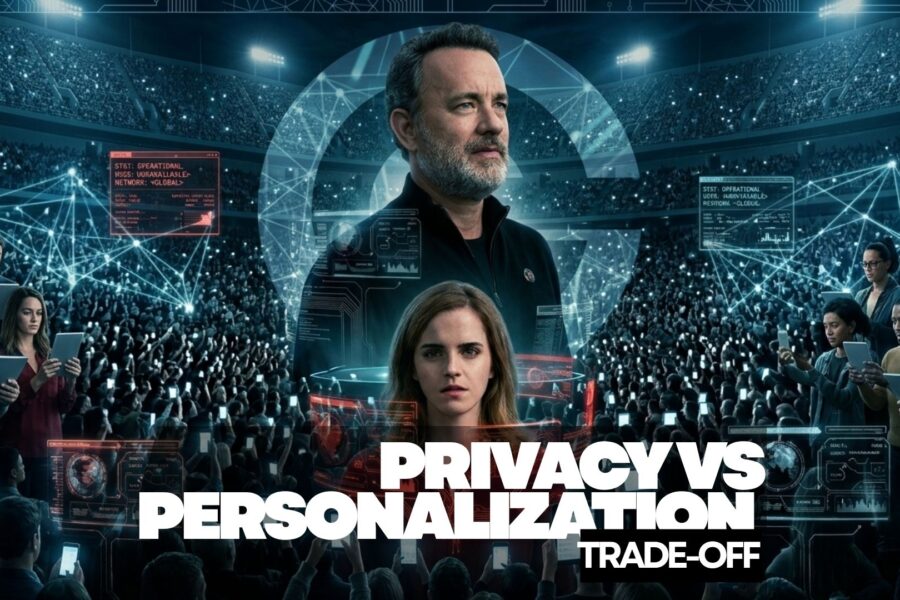
The Circle (2017) shows how people adopt technology not through force, but through convenience, usefulness, and social integration. Using the Technology Acceptance Model, the film reveals how systems become part of everyday life when they feel effortless and valuable.

The Circle: When Useful Technology Becomes Unquestioned
-
- 3 minute read
- 0 Comments
What makes a society willingly adopt a technology that slowly removes its privacy, autonomy, and boundaries? That’s the unsettling question behind The Circle (2017).
At first glance, the film appears to be a standard dystopian thriller about monitoring and technology. But behind the societal critique is something far more realistic: people in The Circle utilise technology because it feels useful and simple. This is exactly what the Technology Acceptance Model (TAM) aims to explain.
How The Circle Uses the Technology Acceptance Model
Mae Holland does not enter The Circle with the aim of giving up her privacy. In fact, her adoption process appears to be quite routine. That is what makes the film effective.
At the beginning of the movie:
- The Circle offers her a prestigious job
- The work environment encourages participation
- The digital ecosystem feels efficient and modern
- Social interaction happens through the platform itself
Mae is not forced into the system. She slowly adapts to it. And this progressing adaption reflects the logic of the Technology Acceptance Model.

Step 1: The Technology Feels Easy
One of the most powerful ideas in TAM is that ease lessens resistance. The Circle ecosystem is intended to reduce friction: a single account, rapid communication, seamless integration, immediate feedback, and social visibility.
Everything runs smoothly. There are no complex barriers. There are no unclear interfaces. There’s no effort. The technology feels natural. When technology seems natural, people stop carefully evaluating it. They simply started utilising it. This is precisely what happens to Mae. Participation initially appears to be harmful. The system inserts itself into daily activities. Without realising it, Mae’s digital participation gradually becomes a social expectation.

Step 2: The Technology Feels Useful
Ease alone is not enough. The Circle’s system also produces a high perceived usefulness. Mae gains visibility, social recognition, connections, influence, and opportunities. The platform continuously encourages interaction. The more active she is, the more value the system appears to provide. This highlights a critical idea underlying current digital platforms.
Technology spreads more rapid when it provides immediate, tangible benefits.
The Circle does not perceive itself as threatening. It perceives itself as beneficial. That is an important distinction. Because most technology adoption does not begin with ethical discussions. It begins with practical convenience.
Technology Adoption and Social Pressure

Another critical dimension of The Circle is social influence—a factor later integrated into advanced versions of TAM. In this ecosystem, visibility becomes social currency, participation is expected, and non-participation is looked down upon. Mae experiences pressure not from direct force, but from the culture around her. This perfectly mirrors modern digital behavior: people often adopt platforms simply because everyone else is on them, workplaces depend on them, and social life becomes inseparable from them. Ultimately, technology adoption is rarely a purely rational choice; it is deeply social.
The Real Question Behind The Circle
The film does not argue that technology is inherently evil. Instead, it poses an unsettling question: what happens when a system becomes too useful to resist?
The Technology Acceptance Model (TAM) explains why this integration seems so natural. From the user’s perspective, the platform truly delivers—simplifying processes, increasing connectivity, and rewarding involvement. Real technology adoption rarely begins with force or oppression, but rather with pure convenience.
This is what contributes to The Circle’s astonishingly realistic environment. Mae isn’t moved by fear or violence. She adapts because the system meets the core principles of TAM: it seems useful, requires no effort, and integrates effortlessly into her social identity. As the platform progressively becomes connected with everyday life, the film offers its most disturbing realisation: Dystopia does not necessarily occur through control. It is sometimes accepted as a form of convenience through oppression. It sometimes arrives through convenience.
For the Brave Souls and Scholars
Venkatesh, V., & Davis, F. D. (2000). A theoretical extension of the technology acceptance model: Four longitudinal field studies. Management science, 46(2), 186-204. https://doi.org/10.1287/mnsc.46.2.186.11926
Sagnier, C., Loup-Escande, E., Lourdeaux, D., Thouvenin, I., & Valléry, G. (2020). User acceptance of virtual reality: an extended technology acceptance model. International Journal of Human–Computer Interaction, 36(11), 993-1007. https://doi.org/10.1080/10447318.2019.1708612
Davis, F. D., Granić, A., & Marangunić, N. (2024). The technology acceptance model: 30 years of TAM (pp. 20-54). Switzerland: Springer International Publishing AG.


Leave a Comment